
Port Washington Garden Club
Gypsy Moth Information Page
The gypsy moth has arrived in Wisconsin, and we need to watch for signs of this destructive pest. Unlike other insects, the female gypsy moth does not fly -- it depends on "hitching a ride" to get to its final destination. For this reason, it is important to inspect vehicles and items transported from areas infested with these pests to be sure they are not carrying the insects or their eggs.
MOTHS FOUND IN PORT WASHINGTON
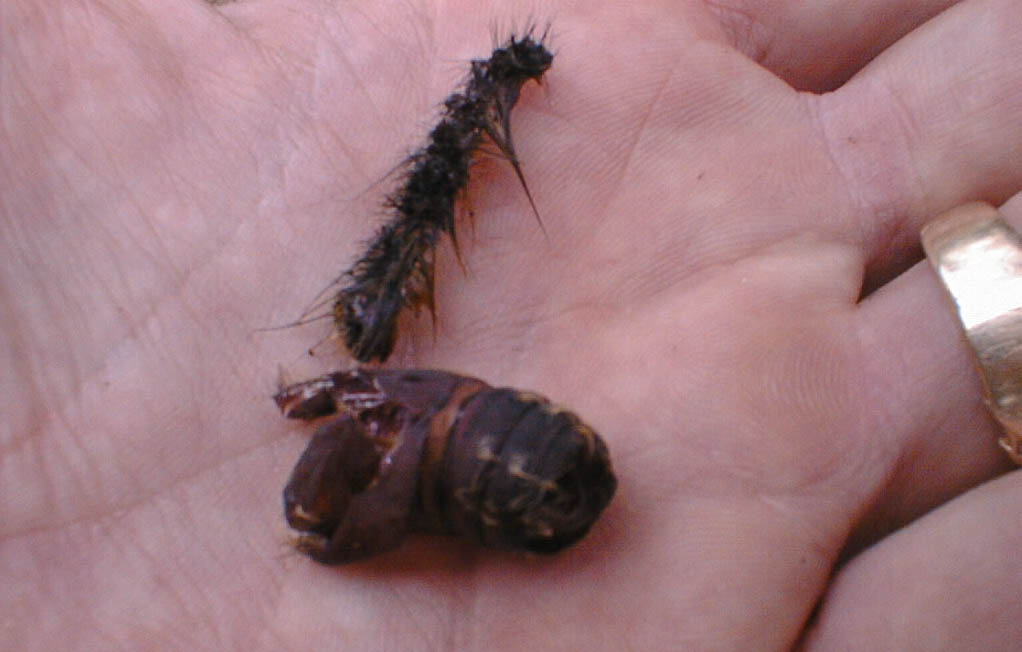
On August 13, 2002, we discovered our first gypsy moth egg masses here in Port Washington on a sugar maple tree in our front yard. The masses were laid under loose chunks of bark that were still attached to the tree. An arborist was visiting to check out some tree problems and when he popped off one of the pieces of bark, the egg mass was found. Next to the egg mass was an empty pupa case. See photos below (click on the image for a larger view).
The egg mass is a tan-colored mass that looks kind of like suede -- Slightly fuzzy. We found the one in the photo above on a sugar maple tree, underneath some loose bark. Since the egg mass was on a loose piece of bark, I simply popped it into the microwave oven and cooked it for three minutes to kill the eggs. DO NOT simply scrape the eggs off onto the ground or into the trash, they will still hatch! Follow the tips on the Gypsy Moth Information Page (below) to dispose of the eggs.
We found a second mass on August 15 in the trunk of a hollow apple tree, along with the female moth. I killed the moth and will spray the egg mass with an oil spray -- this will suffocate the eggs.
MORE INFORMATION
The link below will take you to a very informative web page set up by the U.S. Department of Agriculture Forest Service. It has great photos of gypsy moths, their caterpillars and their egg masses so that you can identify them when you see them in your garden. It also has information on killing the eggs and gives tips on how to avoid serious infestation.
Go to the USDA gypsy moth information page
This is another useful link, from Nova Scotia:
Visit a gypsy moth information page from Nova Scotia
If you have trouble viewing these pages, contact the club via email and we'll make sure you get a copy of the documents!
Back to Port Washington Garden Club home page
This page last edited January 27, 2011